
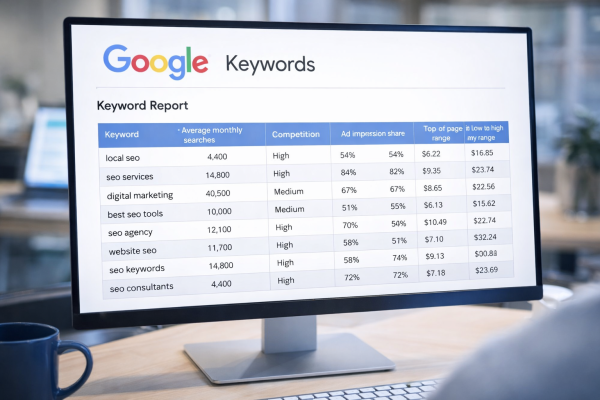
Here is the most common and most costly mistake in small business content marketing: creating content based on what the business owner thinks their customers are searching for, rather than what they are actually typing into Google. The distance between these two things is often enormous — and it is where most SMB content investments go to die.
Keyword research eliminates that guesswork. It replaces assumption with data, and data with direction. A well-executed keyword research engagement produces more than a spreadsheet of search terms — it produces a revenue map: a prioritized, difficulty-weighted, intent-sorted list of the exact queries your buyers use, mapped to the specific pages your website needs to own them. Everything that follows — the blog posts, the service pages, the paid ads, the landing pages — becomes a deliberate execution of that map rather than an improvised guess.
- 70% of Google searches are long-tail keywords — where SMB conversion rates are highest
- 5× higher conversion rate for high-intent vs. generic informational keywords
- 94% of keywords get fewer than 10 searches/month — most are untapped by competitors
Search Intent: The Concept That Separates Good Keyword Research from Great
Not all keywords are created equal. A business owner who spends six months writing content for high-volume keywords with informational intent — questions like “what is SEO” or “how does Google work” — will generate traffic from curious readers who have zero intention of hiring anyone. Meanwhile, their competitor who owns lower-volume, high-commercial-intent keywords like “hire SEO agency Minneapolis” or “how much does SEO cost for small business” is booking calls every week.
Understanding search intent — the underlying motivation behind a query — is the framework that separates keyword research that drives revenue from keyword research that drives traffic. Google organizes this into four categories, and every keyword on your list should be tagged accordingly before a single word of content is written.
Informational
The searcher wants to learn. They are not ready to buy. Target with blog posts and educational guides to build authority and warm leads.
Navigational
The searcher is looking for a specific website or brand. Target with branded pages and ensure your GBP is optimized to capture brand searches.
Commercial
The searcher is researching before buying. High priority — they are in evaluation mode. Target with comparison pages, case studies, and service overviews.
Transactional
The searcher is ready to act. Highest conversion potential. Target with dedicated landing pages and direct CTAs.
For SMBs with limited content budgets, prioritize commercial and transactional intent keywords first. Every dollar of content investment should be traceable to a buyer who is actively evaluating a purchase — not a reader who is casually curious.
The Keyword Research Process: From Seed to List
Professional keyword research begins with seed terms — the broad topics that define a business’s core services — and then systematically expands outward into the full universe of related, modified, long-tail, and competitor-owned variations. The process is methodical, tool-assisted, and grounded in three sources of data: search volume, keyword difficulty, and competitive gap analysis.
| Research Phase | What Happens | Tools Used | Output |
|---|---|---|---|
| Seed Keyword Expansion | Starting from core service terms, expand to all variations, modifiers, and related queries | Moz Keyword Explorer, Google Search Console | Raw keyword universe (200–500+ terms) |
| Search Volume + Difficulty Scoring | Filter by monthly search volume and rank difficulty to find the best effort-to-reward ratio | Moz, Ahrefs, Google Keyword Planner | Filtered shortlist (50–100 priority terms) |
| Intent Classification | Tag every keyword by search intent (informational, commercial, transactional, navigational) | Manual SERP analysis + Moz intent data | Intent-sorted keyword list |
| Competitor Gap Analysis | Identify keywords competitors rank for that the client’s site does not — validated demand, proven opportunity | Moz, Semrush, Ahrefs | Gap keyword list with traffic estimates |
| Local Keyword Layer | Add geographic modifiers (city, neighborhood, metro area) to priority terms for local search capture | Google Autocomplete, Moz Local | Local keyword cluster per service area |
| Page Mapping | Assign each priority keyword to an existing or to-be-created page — one primary keyword per page | Site architecture review | Keyword-to-page map (the content roadmap) |
The Page Map: Turning Research into a Content Architecture
The page map is the deliverable that separates a keyword research engagement from a spreadsheet exercise. It takes the prioritized keyword list and assigns each term — or cluster of related terms — to a specific page on the website. Service pages own commercial and transactional keywords. Blog posts and guides own informational keywords. Location pages own geo-modified local keywords. The map makes clear what pages need to be created, what pages need to be optimized, and what the internal linking structure should look like to maximize the authority flow between them.
- One primary keyword per page, always: Targeting multiple unrelated keywords on a single page dilutes the topical signal. Google ranks pages, not websites — each page should be the definitive resource for one topic.
- Service pages own transactional intent: Your “SEO Services” page should target “SEO agency Minneapolis,” not “what is SEO.” The page’s job is to convert buyers, not educate browsers.
- Blog posts cluster around a pillar page: A pillar page on a broad topic (e.g., “Digital Marketing for Small Businesses”) is supported by cluster posts on specific subtopics. Internal links between cluster and pillar build topical authority across the entire domain.
- Keyword cannibalization kills rankings: When multiple pages on the same site target the same keyword, they compete against each other. The page map identifies and resolves cannibalization before it suppresses your best pages.
- Long-tail clusters compound over time: A page targeting “how much does website redesign cost in Minneapolis” may only receive 50 searches per month — but those 50 people are in active purchasing mode, and the page has virtually no national competition.
The ROI Calculation: Making Keywords a Business Conversation
One of the most powerful aspects of a well-structured keyword research engagement is the ability to connect search volume data directly to a revenue projection. This transforms the keyword list from a technical SEO document into a business case — and it is one of the most effective tools in a discovery call for helping SMB owners understand why this investment is worthwhile.
| Keyword | Monthly Searches | Realistic CTR (Rank 3) | Conversion Rate | Monthly Leads | Revenue Potential |
|---|---|---|---|---|---|
| marketing agency Minneapolis | 320 | 8% | 5% | 1.3 | $3,900+ / mo |
| SEO services small business | 480 | 8% | 4% | 1.5 | $4,500+ / mo |
| website redesign cost Minneapolis | 90 | 15% | 8% | 1.1 | $3,300+ / mo |
| free marketing audit | 260 | 12% | 15% | 4.7 | Pipeline fuel |
Estimates based on industry-average CTR and conversion data; actual results vary by domain authority and content quality.
LeMay Consulting’s Keyword Research to Revenue Engagement
LeMay Consulting delivers keyword research that functions as a strategic business document — not a technical appendix that collects dust. Our keyword research engagements use Moz, Google Search Console, and competitor gap analysis to produce a prioritized, intent-classified keyword list and a complete page map that becomes the editorial backbone for 12 months of content, SEO, and paid media strategy.
- Full keyword universe expansion from core service seeds
- Search volume, difficulty, and intent classification
- Competitor keyword gap analysis included
- Local keyword layer (city, metro, neighborhood)
- Complete keyword-to-page map and content roadmap
- Revenue projection model for priority keywords
The keyword list is the foundation of every other marketing decision you make. Blog posts, Google Ads, landing pages, service page copy — they all perform better when they’re built on research instead of guesswork. Let LeMay build your revenue map. Book a free consultation and we’ll run a preliminary keyword analysis for your business before the call.