The follow-up is where most sales are made — and where most small business sales processes collapse. A prospect downloads an audit guide, fills out a contact form, or attends a webinar. The business owner sends one email. No reply. They send a second email two weeks later. Still no reply. At this point, the prospect is written off as a dead lead — when in reality, they simply haven’t reached the point in their decision timeline where they’re ready to commit.
Research from the National Sales Executive Association shows that 48% of salespeople never follow up after the first contact. 25% make two contacts and stop. Only 10% follow up more than three times — and those 10% close 80% of the sales. The formula is not complicated. It is simply the consistency of value-delivering, appropriately timed follow-up that most SMBs have never systematized. An automated email nurture sequence solves this problem permanently: once built, it follows up on every lead, every time, with the right message at the right stage of the journey — automatically.
- 80% of sales require 5+ touchpoints — most SMBs abandon after 1 or
- $36 average ROI for every $1 spent on email marketing — highest of any digital channel
- 47% higher close rate for nurtured leads compared to non-nurtured leads (Annuitas Group)
The Architecture of an Effective Nurture Sequence
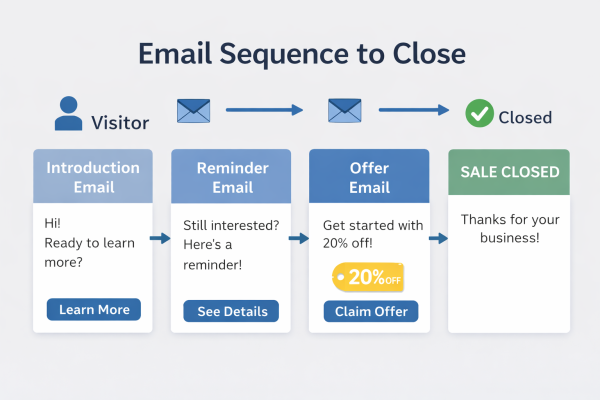
Not all email sequences are nurture sequences. A nurture sequence is specifically designed to move a prospect from initial interest — they raised their hand in some way — through a structured journey of value delivery, trust building, and objection resolution, arriving at the point of conversion naturally rather than through a hard sell. The sequence is not about volume of contact. It is about the quality and relevance of each individual email in the context of where the prospect is in their decision process.
The 7–14 day window is deliberate. It is long enough to deliver meaningful value across multiple touchpoints without saturating the inbox. It maps to the average decision timeline for SMB service purchases — where the initial interest is real but the commitment requires multiple exposures to evidence, social proof, and a clear path to the next step. Every email in the sequence has a single job: deliver one clear piece of value, advance the relationship by one degree, and include one specific call to action.
Every email in a nurture sequence should do exactly one thing well: deliver one insight, tell one story, present one social proof point, or make one specific offer. Emails that try to cover multiple topics dilute attention, reduce click-through rate, and exhaust the subscriber faster.
A Complete 7-Day Service Business Nurture Sequence
The following sequence is designed for a service business prospect who submitted a free audit inquiry or downloaded a lead magnet. The subject lines and objectives below represent the framework — actual content is written to match the specific business’s voice, service offering, and client outcomes.
Day 0
- Your audit request is confirmed — here’s what happens next
- Deliver + Set Expectations
- Immediate send after form submission. Confirms receipt, sets the timeline for the audit delivery, delivers any promised lead magnet, and introduces the business with a one-paragraph human summary (not a company boilerplate). Tone: warm, professional, specific.
- The 3 most common website problems we find (and fix)
- Deliver Value
- A short, genuinely useful educational email that demonstrates expertise. Three specific, concrete problems (not vague platitudes) that the business frequently identifies in audits. No sales pitch — pure value. Goal: establish authority and make the prospect feel they’re learning something real.
Day 4
- How [Client Name] went from 3 leads/month to 18 — in 90 days
- Social Proof
- A specific, named client case study in narrative form. Problem → solution → measurable result. The story format is more persuasive than bullet-point facts because it is emotionally engaging and creates identification: the prospect sees themselves in the client’s before-state.
- The question I get most from Minneapolis business owners
- Objection Handling
- Addresses the most common objection in a conversational, honest format. For a marketing agency this is often “Is this going to work for my industry?” or “How long does it actually take to see results?” Answering the objection proactively, before the prospect has to raise it, is one of the most trust-building moves in a nurture sequence.
- What I’d fix first on your website (based on what I typically see)
- Personalized Value
- Hyper-relevant email that bridges from generic education to personalized application. If the prospect’s website URL was collected at opt-in, this email can reference real observations. If not, it uses the most common findings for the prospect’s business type or industry. Creates the experience of a consultation without being a sales call.
Day 10
- Quick question — is this still a priority for you?
- Re-Engagement Check
- A short, two-sentence re-engagement email. No pitch. Just a genuine check-in. This email consistently generates the highest reply rate in the sequence because it feels personal and low-pressure. Replies — even negative ones (“actually we’ve hired someone”) — are valuable data that allow for list segmentation and lead qualification.
- Last note — your free audit offer expires Friday
- Urgency + Final Offer
- The sequence closer. Restates the original offer with a time-bounded frame. This is not manipulative urgency — it is a natural close to the nurture period. After this email, unconverted leads move to a longer-cadence monthly newsletter rather than exiting the relationship entirely.
Writing Emails That Get Opened: Subject Line Strategy
No nurture sequence delivers results if the emails don’t get opened. Subject line performance is the single most lever-able variable in email marketing — the same email with a strong subject line versus a weak one can see open rate differences of 30–50 percentage points. The following principles apply across all business types and audience segments.
| Subject Line Principle | Example | Why It Works |
|---|---|---|
| Specificity over vagueness | “How we increased [Client]’s leads by 60%” | Specific results create curiosity; vague promises create skepticism |
| Question format | “Is your website actually generating leads?” | Questions create cognitive engagement — readers answer mentally before opening |
| First-person directness | “What I’d fix first on your site” | Personal framing breaks the pattern of corporate email blasts |
| Local reference (where relevant) | “What Minneapolis service businesses miss about SEO” | Local specificity increases relevance and trust in community-oriented markets |
| Curiosity gap | “The 3 things your competitor’s agency isn’t telling them” | Opens a question the reader needs to resolve — compels the open |
| Ultra-short subject lines | “Quick question” / “Still interested?” | Pattern interruption — stands out in inbox full of long, formatted subjects |
Automation Platform Selection for SMBs
Building a nurture sequence requires an email marketing platform with automation capability. The right choice depends on the business’s current CRM setup, contact volume, and budget. For most Minneapolis-area SMBs without an enterprise tech stack, the following platforms represent the practical spectrum from starter to scaling.
- Mailchimp (Starter–$20/month): Best entry point for businesses under 500 contacts. Simple automation builder, adequate analytics, and direct Calendly integration. Sufficient for a 7-email sequence with basic segmentation.
- ActiveCampaign ($29/month+): The SMB sweet spot. Advanced automation logic, CRM integration, conditional branching (different sequences based on what the lead clicked), and lead scoring. The platform of choice for agencies building sophisticated multi-sequence systems.
- HubSpot (Free–$800/month): The most comprehensive option, combining CRM, email, and pipeline management in one platform. The free tier is usable for basic nurture sequences. The paid tiers unlock the full power of behavior-triggered automation.
- Klaviyo (E-commerce focused): Best for SMBs with an e-commerce component. Exceptional segmentation and behavioral triggers based on purchase history and browse behavior. Less suited for pure service businesses.
LeMay Consulting’s Email Nurture Sequence Build
LeMay Consulting writes and builds email nurture sequences for Minneapolis-area service businesses that follow up consistently, deliver genuine value, and convert more leads into booked consultations — without requiring the business owner to manually compose another follow-up email. Our sequences are written in the business’s voice, built inside the client’s email platform of choice, tested for deliverability, and handed off with a plain-English performance dashboard so you can see open rates, click rates, and conversions at a glance.
- 7–14 email sequence — full copywriting included
- Platform setup in Mailchimp, ActiveCampaign, or HubSpot
- Subject line A/B testing configuration
- Segmentation for engaged vs. cold leads
- Calendly booking link integration
- Monthly performance report — opens, clicks, conversions
If you have collected leads over the past 12 months who never converted, a well-written nurture sequence sent to that list can generate new business from contacts you already own — at zero additional acquisition cost. Book a consultation and we will assess your current follow-up process and show you exactly where conversations are going cold.